
In short
On the U.S. labels, nausea affected up to 44% of adults, against 16% on placebo in that trial group. It mostly happens while the dose is going up, and tends to ease. Smaller meals and avoiding fatty food are the usual first steps. Vomiting that will not stop needs a call to your provider.
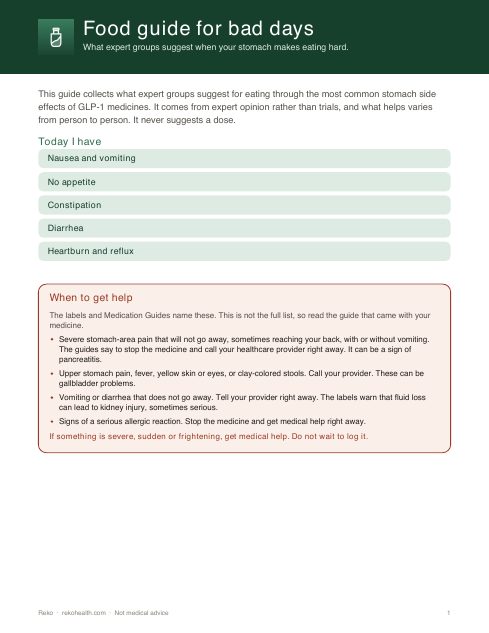 Get the free food guide for bad daysWhat expert groups suggest for nausea, no appetite, constipation, diarrhea and heartburn.
How common it is
| Label | Nausea | On placebo | Vomiting | On placebo |
|---|---|---|---|---|
| Ozempic (0.5, 1 mg) | 15.8%, 20.3% | 6.1% | 5%, 9.2% | 2.3% |
| Mounjaro (5, 10, 15 mg) | 12%, 15%, 18% | 4% | 5%, 5%, 9% | 2% |
| Wegovy (2.4 mg) | 44% | 16% | 24% | 6% |
| Zepbound (5, 10, 15 mg) | 25%, 29%, 28% | 8% | 8%, 11%, 13% | 2% |
Share of people in the labels' placebo-controlled trials. Ozempic and Mounjaro figures are from people with type 2 diabetes, and Zepbound and Wegovy from people with obesity or overweight, so the rows are not a comparison between medicines.
When it happens
All four labels say these reactions were reported mostly while the dose was being raised. The Mounjaro and Zepbound labels add that they decreased over time. One expert consensus says nausea is most common in the first 4 to 5 weeks and usually settles within about 8 days of beginning. Another advisory notes it often comes in the morning or after long gaps without food.
What experts suggest
These come from expert groups rather than trials, and what helps varies from person to person.
- Eat smaller meals, more often, and stop when you feel full. Large meals make vomiting more likely.
- Go easy on fatty food, and on high-fiber food in the first days.
- Have a small breakfast, then something small every 3 to 4 hours, with enough fluids.
- Try crackers, apples, ginger or peppermint tea, and avoid strong smells.
- If it continues, have drinks 30 to 60 minutes away from meals.
For food ideas, see what to eat on a GLP-1. If vomiting or diarrhea leaves you short of fluids, the daily water estimate gives a starting point. Our side effects guide covers the others.
What to ask your prescriber
Anti-nausea medicine, staying on a dose longer, or changing your schedule are decisions for your prescriber. Do not change a dose on your own.
When to get help
The labels and Medication Guides name these. This is not the full list, so read the guide that came with your medicine.
- Severe stomach-area pain that will not go away, sometimes reaching your back, with or without vomiting. The guides say to stop the medicine and call your healthcare provider right away. It can be a sign of pancreatitis.
- Upper stomach pain, fever, yellow skin or eyes, or clay-colored stools. Call your provider. These can be gallbladder problems.
- Vomiting or diarrhea that does not go away. Tell your provider right away. The labels warn that fluid loss can lead to kidney injury, sometimes serious.
- Signs of a serious allergic reaction. Stop the medicine and get medical help right away.
If something is severe, sudden or frightening, get medical help. Do not wait to log it.
How Reko helps
Log nausea the day it happens, with how strong it was. Reko keeps your symptoms beside your doses, so you can show your prescriber when something began and how it changed. It does not tell you what a symptom means, and it never suggests a dose.
Questions people ask
How long does GLP-1 nausea last?
One expert consensus says it is most common in the first 4 to 5 weeks and usually settles within about 8 days of beginning. The same paper says vomiting lasts 1 to 8 days. If yours does not go away, tell your provider right away.
What can I eat when I feel sick on a GLP-1?
Expert groups suggest small meals, crackers, apples, and ginger or peppermint tea, and avoiding fatty food and strong smells. These suggestions come from expert opinion rather than trials.
Why is my nausea worse in the morning?
A 2025 joint advisory notes nausea often comes in the morning or after long gaps without food. It suggests a small breakfast, then something small every 3 to 4 hours.
Is nausea worse at higher doses?
On the Mounjaro and Ozempic labels the rate rises with the dose. On the Zepbound label it is similar at 10 and 15 mg. The table above shows each figure.
Can I take anti-nausea medicine with a GLP-1?
Expert groups mention anti-nausea medicine, but whether it suits you is a decision for your prescriber.
Does nausea mean the medicine is working?
The labels do not say that. Nausea is listed as a side effect, and how much you feel it does not tell you how well the medicine works.
Will it go away?
For many people it eases, and the labels say it was reported mostly during dose increases. If it does not go away, tell your provider.
Reko records what you and your prescriber decide. This guide is general information and not medical advice.
Read next
Recipes to try
These are ordinary recipes and do not treat any side effect.
Useful tools
- Mounjaro prescribing information on DailyMed. Checked 2 November 2026.
- Zepbound prescribing information on DailyMed. Checked 2 November 2026.
- Ozempic prescribing information on DailyMed. Checked 2 November 2026.
- Wegovy prescribing information on DailyMed. Checked 2 November 2026.
- Gorgojo-Martínez JJ et al. Clinical recommendations to manage gastrointestinal adverse events in patients treated with GLP-1 receptor agonists: a multidisciplinary expert consensus. J Clin Med 12(1):145. An expert consensus, not a trial.
- Mozaffarian D et al. Nutritional priorities to support GLP-1 therapy for obesity: a joint advisory. Am J Clin Nutr 2025;122(1):344-367. Mostly expert opinion.