
In short
The most common side effects are stomach and bowel problems: nausea, diarrhea, vomiting and constipation. On the labels they were reported mostly while the dose was going up. Most practical advice comes from expert groups, not trials. Severe stomach pain that will not go away needs a call to your provider right away.
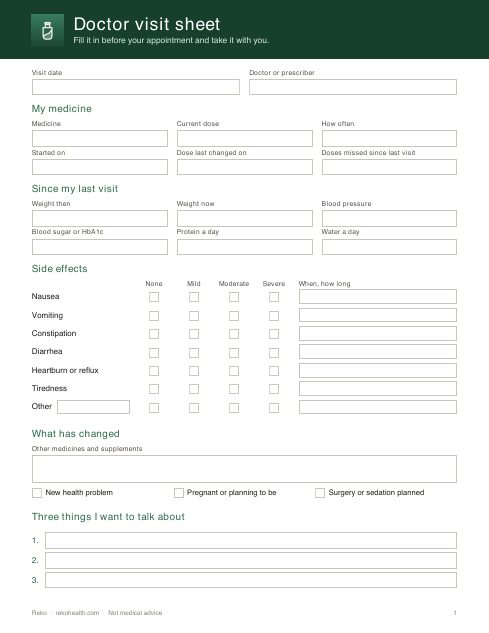 Get the free doctor visit sheetTwo pages to fill in before your appointment, with 14 questions to ask.
How to use these guides
Start with the symptom you have. Each guide follows the same order: how common it is on the U.S. labels, what expert groups suggest, what to ask your prescriber, and when to get help. The rates come from the labels' placebo-controlled trials. The suggestions come from expert groups and consensus papers, not from trials, and what helps varies from person to person.
None of the guides tells you to change a dose, and none gives one. Anti-nausea medicine, laxatives, acid-reducing medicine, waiting before a dose increase and any change to your schedule are decisions for your prescriber or pharmacist. Where the sources say little, the guides say so: for fatigue we found nothing on when it starts or how long it lasts.
Guides by side effect
What each guide covers
- Nausea and vomiting. On the labels, nausea affected up to 44% of adults on Wegovy 2.4 mg, against 16% on placebo. All four labels say these reactions were reported mostly while the dose was being raised, and the Mounjaro and Zepbound labels add that they decreased over time. Expert groups suggest smaller meals, going easy on fatty food, and a small breakfast followed by something small every 3 to 4 hours.
- Constipation. Up to 24% on Wegovy 2.4 mg, against 11% on placebo. One expert consensus reports a median of 47 days in people with obesity, longer than other stomach side effects. Fluids, adding fiber gradually and moving more are the usual first steps; ask before starting a laxative or supplement.
- Diarrhea. Up to 30% on Wegovy 2.4 mg, against 16% on placebo. One consensus says it starts in the first four weeks and lasts about 3 days in people with obesity. Fluids come first, because the labels warn about dehydration and kidney injury.
- Heartburn, reflux and burping. Reflux up to 5%, indigestion up to 10% and burping up to 7% on the labels. The advice, smaller portions and not lying down after meals, rests largely on one case discussion, so the evidence is weak.
- Fatigue. Listed on the Wegovy and Zepbound labels, in up to 11% and 7% of people, against 5% and 3% on placebo. The sources give no timing and no advice aimed at fatigue itself, only things worth checking with your prescriber, such as how much you are eating.
- Hair loss. Zepbound lists it in up to 5% of people, against 1% on placebo, and Wegovy 2.4 mg in 3%, against 1%. It was more common in women. Whether the medicine itself causes it is not established.
- Muscle loss and protein. In a SURMOUNT-1 substudy about 75% of the weight lost was fat and about 25% was lean mass, which is more than muscle. A 2025 joint advisory says protein alone is likely inadequate without structured resistance training.
- What to eat. The same advisory reports that people on these medicines eat 16% to 39% less, so each meal has more work to do. It suggests small frequent meals when appetite is low, and fiber advice that depends on your symptoms.
How common they are
The highest rate on each U.S. label's main table, with placebo in brackets.
| Side effect | Wegovy 2.4 mg | Zepbound | Ozempic | Mounjaro |
|---|---|---|---|---|
| Nausea | 44% (16%) | 29% (8%) | 20.3% (6.1%) | 18% (4%) |
| Diarrhea | 30% (16%) | 23% (8%) | 8.8% (1.9%) | 17% (9%) |
| Vomiting | 24% (6%) | 13% (2%) | 9.2% (2.3%) | 9% (2%) |
| Constipation | 24% (11%) | 17% (5%) | 5% (1.5%) | 7% (1%) |
| Indigestion | 9% (3%) | 10% (4%) | 3.5% (1.9%) | 8% (3%) |
| Fatigue | 11% (5%) | 7% (3%) | No exact figure | Not in this table |
| Hair loss | 3% (1%) | 5% (1%) | No rate | No rate |
Ozempic and Mounjaro figures are from people with type 2 diabetes, and Zepbound and Wegovy from people with obesity or overweight, so the columns are not a comparison between medicines. This table does not list every side effect.
Reading the table
Each figure is the highest rate on that label's main table, so a medicine with several doses shows its top figure. The placebo figure in brackets is the share of people who reported the same thing without taking the medicine, which is why a rate that looks high on its own can be read against it. Wegovy and Zepbound were studied in people with obesity or overweight, and Ozempic and Mounjaro in people with type 2 diabetes. The groups of people differ, so the columns cannot be ranked against each other. A side effect missing from the table is not proof that it is rare: the table lists only some of them.
When to get help
The labels and Medication Guides name these. This is not the full list, so read the guide that came with your medicine.
- Severe stomach-area pain that will not go away, sometimes reaching your back, with or without vomiting. The guides say to stop the medicine and call your healthcare provider right away. It can be a sign of pancreatitis.
- Upper stomach pain, fever, yellow skin or eyes, or clay-colored stools. Call your provider. These can be gallbladder problems.
- Vomiting or diarrhea that does not go away. Tell your provider right away. The labels warn that fluid loss can lead to kidney injury, sometimes serious.
- Signs of a serious allergic reaction. Stop the medicine and get medical help right away.
If something is severe, sudden or frightening, get medical help. Do not wait to log it.
When food is hard, our high-protein recipes keep portions small.
What to bring to your provider
The guides keep returning to the same point: a pattern is easier to act on than a general feeling. Note the date a symptom began, how strong it was, how it changed, and what you were eating and drinking around it. Our free doctor visit sheet has two pages to fill in before an appointment, with 14 questions to ask. For symptoms that involve fluid loss, the daily water estimate gives a starting point to discuss, not a target.
Keeping a record
A dated record helps you tell your prescriber when something began and how it changed. See why keeping a record helps and how Reko tracks side effects. Reko does not tell you what a symptom means, and it never suggests a dose.
Questions people ask
What are the most common side effects of GLP-1 medicines?
Stomach and bowel problems: nausea, diarrhea, vomiting and constipation. On the Wegovy 2.4 mg label, nausea was reported by 44% of people, against 16% on placebo.
When do GLP-1 side effects happen?
All four U.S. labels say nausea and vomiting were reported mostly while the dose was being raised, and the Mounjaro and Zepbound labels add that they decreased over time. Fatigue is different: we found no source on when it starts or how long it lasts.
Can I compare the side effect rates of Ozempic, Mounjaro, Wegovy and Zepbound?
Not directly. Ozempic and Mounjaro figures come from people with type 2 diabetes, and Wegovy and Zepbound from people with obesity or overweight, so the columns are not a comparison between medicines.
Is the advice in these guides from clinical trials?
The rates are from the labels' placebo-controlled trials. The practical suggestions, such as smaller meals or more fluids, come from expert groups and consensus papers rather than trials, and what helps varies from person to person.
When should I call my provider about a side effect?
Call your provider right away for severe stomach-area pain that will not go away, which the guides say can be a sign of pancreatitis, and tell your provider if vomiting or diarrhea does not go away, because the labels warn that fluid loss can lead to kidney injury. For signs of a serious allergic reaction, stop the medicine and get medical help right away.
Do these guides tell me what dose to take?
No. Decisions about medicine and dose belong to your prescriber, and Reko never suggests a dose.
Useful tools
Reko records what you and your prescriber decide. This guide is general information and not medical advice.
- Mounjaro prescribing information on DailyMed. Checked 2 November 2026.
- Zepbound prescribing information on DailyMed. Checked 2 November 2026.
- Ozempic prescribing information on DailyMed. Checked 2 November 2026.
- Wegovy prescribing information on DailyMed. Checked 2 November 2026.
- The expert consensus papers and joint advisories cited above are listed in full in each linked guide.