
In short
On the U.S. labels, diarrhea affected up to 30% of people, against up to 16% on placebo. One expert consensus says it starts in the first four weeks and lasts about 3 days in people with obesity. Fluids come first, because the labels warn about dehydration and kidney injury. If it does not go away, tell your provider right away.
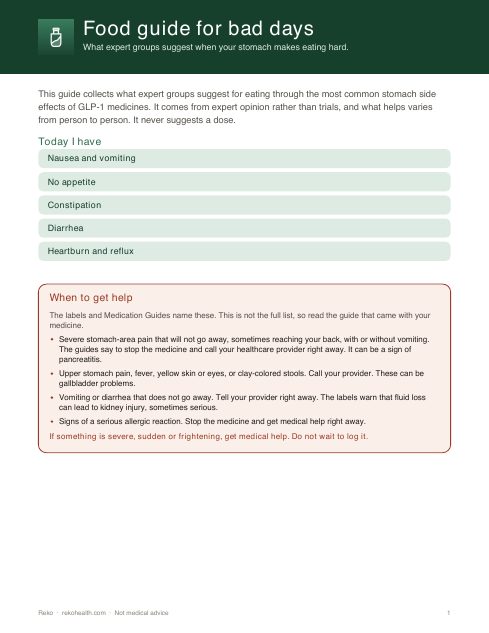 Get the free food guide for bad daysWhat expert groups suggest for nausea, no appetite, constipation, diarrhea and heartburn.
How common it is
| Label | Diarrhea | On placebo |
|---|---|---|
| Ozempic (0.5, 1 mg) | 8.5%, 8.8% | 1.9% |
| Mounjaro (5, 10, 15 mg) | 12%, 13%, 17% | 9% |
| Wegovy (2.4 mg) | 30% | 16% |
| Zepbound (5, 10, 15 mg) | 19%, 21%, 23% | 8% |
Share of people in the labels' placebo-controlled trials. Ozempic and Mounjaro figures are from people with type 2 diabetes, and Zepbound and Wegovy from people with obesity or overweight, so the rows are not a comparison between medicines.
What experts suggest
These come from expert groups rather than trials.
- Drink plenty of fluids. One consensus suggests avoiding sports drinks.
- Avoid large or high-fat meals, and keep alcohol to a minimum.
- Try cutting back on dairy, coffee, soft drinks, very hot or cold foods, and sweeteners ending in "-ol", such as sorbitol.
- For a short time, swap high-fiber foods for broth, rice, carrots or very ripe skinless fruit.
The daily water estimate gives a starting point for fluids. For the opposite problem, see GLP-1 constipation, and what to eat on a GLP-1 has more on food. The side effects guide covers the others.
What to ask your prescriber
Antidiarrheal medicine, probiotics and fiber products are mentioned by expert groups. If you also take metformin, ask whether it plays a part. These are decisions for your prescriber.
When to get help
The labels and Medication Guides name these. This is not the full list, so read the guide that came with your medicine.
- Severe stomach-area pain that will not go away, sometimes reaching your back, with or without vomiting. The guides say to stop the medicine and call your healthcare provider right away. It can be a sign of pancreatitis.
- Upper stomach pain, fever, yellow skin or eyes, or clay-colored stools. Call your provider. These can be gallbladder problems.
- Vomiting or diarrhea that does not go away. Tell your provider right away. The labels warn that fluid loss can lead to kidney injury, sometimes serious.
- Signs of a serious allergic reaction. Stop the medicine and get medical help right away.
If something is severe, sudden or frightening, get medical help. Do not wait to log it.
How Reko helps
Log each day it happens, along with your water. Reko keeps your symptoms beside your doses, so you can show your prescriber when something began and how it changed. It does not tell you what a symptom means, and it never suggests a dose.
Questions people ask
How long does GLP-1 diarrhea last?
One expert consensus says it starts in the first four weeks, then notably decreases, and lasts about 3 days in people with obesity. If it does not go away, tell your provider right away.
What should I eat with diarrhea on a GLP-1?
One consensus suggests, for a short time, broth, rice, carrots and very ripe skinless fruit in place of high-fiber foods, and avoiding large or high-fat meals.
Which foods can make GLP-1 diarrhea worse?
Expert groups mention high-fat meals, alcohol, dairy, coffee, soft drinks, very hot or cold foods, and sweeteners such as sorbitol. What affects you may differ.
Can I take an antidiarrheal with a GLP-1?
Expert groups mention antidiarrheal medicine, but whether it suits you is a decision for your prescriber.
Why does fluid matter so much?
The labels report kidney injury, in some cases serious, mostly after stomach side effects that led to dehydration. The Medication Guides say it is important to drink fluids.
Should I stop the medicine?
Ask your provider. If you have severe stomach pain that will not go away, the Medication Guides say to stop and call right away.
Reko records what you and your prescriber decide. This guide is general information and not medical advice.
Read next
Recipes to try
These are ordinary recipes and do not treat any side effect.
Useful tools
- Mounjaro prescribing information on DailyMed. Checked 2 November 2026.
- Zepbound prescribing information on DailyMed. Checked 2 November 2026.
- Ozempic prescribing information on DailyMed. Checked 2 November 2026.
- Wegovy prescribing information on DailyMed. Checked 2 November 2026.
- Gorgojo-Martínez JJ et al. Clinical recommendations to manage gastrointestinal adverse events in patients treated with GLP-1 receptor agonists: a multidisciplinary expert consensus. J Clin Med 12(1):145. An expert consensus, not a trial.
- Mozaffarian D et al. Nutritional priorities to support GLP-1 therapy for obesity: a joint advisory. Am J Clin Nutr 2025;122(1):344-367. Mostly expert opinion.